Our Pipeline
Therapeutic Pipeline: Genetic Code Expansion from Research to Neurodegenerative Programs
Tiragena’s pipeline progresses systematically across three phases, with each building on the success of the previous stage. Our phased approach balances near-term revenue generation with long-term therapeutic impact.
Genetic code expansion science overview · Peer-reviewed publications archive · Science blog · ChemSynBio lab
Forward-looking notice: Development stages, timelines, and regulatory outcomes are uncertain. Nothing on this page guarantees approval, labeling, or commercial success.
Phase I: Research protein products
Establishing revenue & scientific credibility (Years 1–2) · Status: Active development
Focus: Premium B2B research reagents for biopharma and academic labs.
Product 1: Homogeneously phosphorylated tau proteins
The innovation: First commercial source of site-specifically phosphorylated tau proteins with homogeneous phosphorylation at all 85 potential sites; single-site and multi-site variants; validated by mass spectrometry; 95% purity.
Applications — Alzheimer’s research: Mechanistic studies; drug screening for aggregation inhibitors; antibody development. Diagnostic development: Biomarker calibration; immunoassay standards; clinical test validation.
Target customers: Academic neuroscience labs; pharmaceutical R&D; diagnostic companies; biotech developing tau therapeutics. Market position: Unique offering; $500–2,000 per 100 µg; growing Alzheimer’s research reagents market ($8B+ annually).
Product line: Year 1: 5–10 key phosphorylation sites (Ser199, Ser202, Thr231, Ser396, etc.); Year 2: 20–30 variants including combinations; custom phosphorylation patterns on request.
Product 2: Clickable antibodies
The innovation: Site-specific incorporation of click chemistry handles—defined DAR; superior homogeneity vs. traditional methods; retained antigen binding; multiple click options (azide, alkyne, tetrazine).
Applications: ADC development; diagnostics & imaging; research tools. Service offerings: Standard IgG with clickable ncAAs; custom sequences; full conjugation services; platform licensing.
Pricing: Research-grade antibodies $1,000–5,000 per mg; custom conjugation $10K–50K; platform licensing negotiated.
Product 3: Custom engineered proteins
The service: Contract protein engineering incorporating client-specified ncAAs—50+ validated ncAAs; proteins up to 100 kDa; multiple incorporation sites; GMP-compatible processes. Process: Feasibility ($5K–15K); optimization & production ($25K–100K); characterization; commercial licensing.
Phase II: Antibody–drug conjugates
Precision oncology therapeutics (Years 3–5) · Status: Preclinical development
Focus: Next-generation ADCs leveraging the clickable antibody platform.
Our advantage: Superior DAR control; enhanced therapeutic index; reproducible manufacturing; established platform from Phase I products.
Lead candidate 1 — HER2-targeted ADC: Indication HER2+ breast and gastric cancer; trastuzumab-based or next-generation anti-HER2; MMAE payload; DAR 4; cleavable or non-cleavable linker.
Lead candidate 2 — Solid tumor ADC: EGFR+, TROP-2+, or Nectin-4+ tumors; novel payloads (PBD dimers, topoisomerase inhibitors); DAR 2–4.
Lead candidate 3 — Hematological ADC: CD19+, CD22+, or BCMA+ blood cancers; high-potency payloads; DAR 2; rapid cellular uptake.
Phase III: Protein editing therapies
Revolutionary treatment for age-related disease (Years 5+) · Status: Platform development
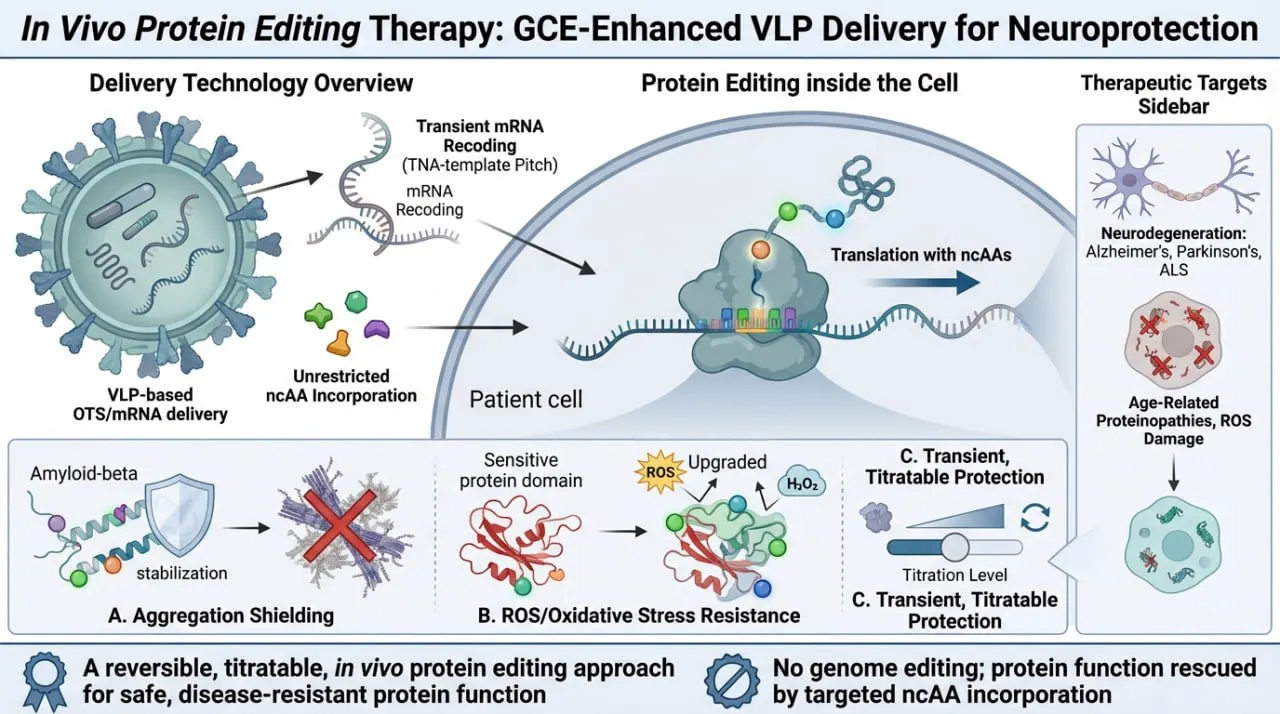
Focus: In vivo protein editing for neurodegenerative diseases and aging.
The paradigm shift: From symptom management to disease prevention—modify disease-causing proteins in vivo; prevent toxic aggregation; resist oxidative damage; maintain proteostasis.
Safety profile: Transient mRNA delivery (no DNA changes); reversible and dose-controllable; tissue-specific targeting; repeat dosing as needed.
Program 1: Alzheimer’s disease — tau editing
Indication: Early to moderate Alzheimer’s disease. Target population: ~6.7M patients in US; biomarker-positive (elevated CSF p-Tau, amyloid PET+); MMSE 20–26.
Therapeutic strategy: Oxidation-resistant tau; aggregation-blocking tau; stabilized tau (proline analogs in microtubule-binding repeats). Delivery: CNS-targeted LNPs; intrathecal or IV; monthly or quarterly dosing.
Program 2: Parkinson’s disease — alpha-synuclein editing
Indication: Early Parkinson’s disease
Target population:
- 1M patients in US
- Hoehn & Yahr Stage 1-2
- Dopaminergic deficit confirmed by DaTscan
Therapeutic strategy:
Oxidation-proof α-synuclein:
- Prevent ROS-induced aggregation triggers
NAC domain modification:
- Block hydrophobic core formation
- Prevent Lewy body assembly
Tetrameric stabilization:
- Cross-linking ncAAs to maintain soluble tetramer
- Prevent pathogenic monomer accumulation
Delivery:
- Substantia nigra-targeted VLPs
- Stereotactic injection or systemic with CNS penetration
- Quarterly dosing protocol
Program 3: ALS — SOD1 & TDP-43 editing
Indication: ALS (SOD1 mutations, sporadic with TDP-43 pathology)
Target population:
- 30K patients in US
- Familial SOD1 mutations (~20% of cases)
- Sporadic with TDP-43 aggregation (~45% of cases)
Therapeutic strategy:
SOD1 stabilization:
- Metal-chelating ncAAs at active site
- Enhanced Cu/Zn binding
- Prevention of misfolding and aggregation
TDP-43 cytoplasmic exclusion:
- Modified RNA-binding domains
- Prevent aberrant phase separation
- Maintain nuclear localization
Delivery:
- Intrathecal LNP-mRNA
- Direct CNS access to motor neurons
- Monthly dosing
Program 4: Age-related macular degeneration
Indication: Dry AMD (geographic atrophy)
Target population:
- 11M patients in US (dry AMD)
- No approved therapies
- Progressive vision loss
Therapeutic strategy:
RPE65 photo-stabilization:
- Photo-stable tyrosine variants
- Resist retinal photo-oxidation
- Maintain visual cycle function
ABCA4 oxidation protection:
- Selenocysteine analogs at vulnerable cysteines
- Prevent lipofuscin accumulation
Complement factor modulation:
- Reduce drusen-associated inflammation
Program 5: Aging & proteostasis (long-term)
Concept: General enhancement of cellular protein quality control
Approach:
- Enhanced chaperones (Hsp70, Hsp90)
- Optimized proteasome function
- Improved antioxidant defenses
Target applications:
- Age-related frailty
- Sarcopenia
- Cognitive decline in healthy aging
Status: Research stage, 5-10 year horizon
Learn more
Investors: Investors · Patients: Patients · Science: Science & technology.
General company inquiries: